Weight Loss
Dec 30, 2025
9 min read
How to Cheat at Weight Loss
Tactical tools to help increase satiation to make adjusting to a calorie deficit easier.
Tactical tools to help increase satiation to make adjusting to a calorie deficit easier.
Recently my girlfriend accused me of “cheating” at weight loss, which of course I found exceptionally flattering.
Here’s a post offered as a “cheat sheet” to help you do the same. We’ll start by concisely reviewing some important basic principles and tactics for losing weight, before moving into some trickier “biohacks” or “cheats.”
(I’ll define a “biohack” or “cheat” as a certain tactic that may not be widely appreciated, that has an outsized positive effect caused by a clear mechanism, that requires relatively minimal effort.)
PRINCIPLE: You must be in a caloric deficit to lose weight.
Before we get into anything fancy, this may be achieved by simply having smaller portions. If you feel you have to always finish everything on your plate, you may simply lose weight by deciding to drop that habit. Eating slowly also profoundly helps people eat less (with an effectiveness that is uncanny). If that advice is all it takes for you to lose weight, then wonderful. If you’re still struggling, then read on.
PRINCIPLE: Not all food is created equal.
Highly refined foods tend to be very caloric and low in nutrients, while minimally refined foods tend to be less calorically dense but very nutritious. Further, certain foods have a high “thermic effect,” i.e. 20-30% of the calories in lean protein are burned simply during its metabolism. Generally speaking, minimally refined whole foods tend to give your body the nutrients it needs to keep you feeling good, happy, and full, without providing too many calories.
PRINCIPLE: Both exercise and nutrition can put you in a caloric deficit, but more often than not, focusing on nutrition is the more potent lever.
Here's my experience as a trainer: it’s extremely difficult, if not impossible, for the average person to out-train a poor diet. On the other hand, someone who prioritizes getting their diet into a caloric deficit first (ideally eating minimally refined foods), and then adds in even a small amount of exercise, is in an excellent position to lose weight.
Before you skip ahead, review this quick list first. There might be something here that, on its own, makes a big difference in your weight loss process.
Tactic: Consume plenty of lean protein. Whether from lean meat, egg whites, or a whey protein powder (mixed with water or almond milk), this macronutrient will help keep you satisfied and protect your muscle mass, while providing a much-needed minimal-calorie alternative to other foods.
Tactic: Consume plenty of veggies and plants. To start, aim for at least one sizeable plant-based meal or snack per day. Once you establish the habit, add more.The fiber in plants will fill you up while feeding your gut biome (which comprises a significant portion of the total cells in your body). Veggies are also an extremely low-calorie option.
Tactic: Consume lots of water. Stay hydrated to feel better, less headache-y, and somewhat less hungry throughout the day. If you like, use bubbly water, since it feels satisfying, or drink tons of tea all day. (More on this later.)
Tactic: For sugar cravings, use fruit. When feeling “fuzzy,” like your blood sugar is low, or simply like you’re craving sugar, try fresh or frozen fruit as a delicious and relatively low-calorie way to satisfy that craving.
Tactic: De-stress. Deliberately take time out of the day to relax to help counter the cortisol-raising effects of calorie deficits. In addition to deep breathing, and my favorite, naps, an excellent option is to try walking – the visual input as you move through space, or “optic-flow,” has a calming effect, even while the movement elevates your metabolism.
Tactic: Fill nutritional gaps. Whether by taking a multivitamin (after a meal, not on an empty stomach), or by drinking a greens juice such as AG1, a broad supplement designed to fill nutritional gaps can be particularly useful when limiting total food intake.
The tactics above are going to be crucial, especially eating lean protein, veggies, and drinking lots of water. Even still, though, caloric deficits often feel uncomfortable, especially at first. The first 1-2 weeks are the very hardest, in my experience, as your ghrelin (hunger hormone) levels begin to adapt. (For some people, this can take 1-3 months.) Here are some biohacks, or cheats, to help you with the process. I list them “tamest” first, starting with some mildly under-appreciated approaches, and easing progressively into what might earn you the high honor of being accused of “cheating at fat loss.”
CHEAT: Eat more salt. (And electrolytes in general.) While eating minimally refined food and drinking lots of water, adding in some salt alongside can be extremely helpful, improving your mood and reducing brain fog. Salt, an electrolyte, plays a critical role in the signaling of neurons. It also has zero calories. TRUE: the majority of Americans ingest way too much salt from eating out frequently. HOWEVER: many people taking fat loss seriously are making the wise decision to avoid dining out. They may also be either intermittent-fasting or simply eating small portions of whole foods, and end up not getting enough salt. Resist the urge to dismiss this nutrient as categorically “unhealthy.” Work smarter, not harder. When appropriate, include salt.
CHEAT: Get more daylight. Simply go on a walk, or just stand outside, and do it frequently. I list this as a “cheat” or “biohack” because its effects are underappreciated and uncannily effective. Sunlight doesn’t only provide vitamin D, it also has the lesser-known effects of boosting serotonin, dopamine, enhancing your circadian rhythm, and functioning as a natural appetite-suppressant. Plus, it’s an easy and enjoyable tactic. Use it shamelessly. (Just wear sunscreen and don’t get sunburned or dehydrated.)
CHEAT: Use non-nutritive sweeteners. I know, this is extremely contentious. My current opinion (shared by some of the brightest minds in nutrition science and backed by randomized controlled human trials), is that overall, substituting sugar with a low-calorie sweetener is safe, satisfying, and reduces caloric intake. Dr. Layne Norton, for example, compellingly argues that diet sodas and non-nutritive sweeteners are effective real-world tools with a long track record of studies to support their efficacy. He points out that randomized controlled trials very clearly show that when exchanged for sugary beverages, sugar-free options really do help people lose significant weight. Further, Americans are most likely to die from heart disease, which is caused by eating too many calories (or what Layne calls “energy toxicity”), and Dr. Norton argues that overall, non-nutritive sweeteners’ very real fat loss benefits outweigh their alleged risks (many of which are overstated or come from outright misreads of the literature). While I’m open to adjusting this stance in the face of enough compelling evidence to the contrary, in the meantime, it’s no wonder I personally see bodybuilders on highly aggressive “cuts” still treating themselves to Diet Dr. Pepper.
CHEAT: Blunt your appetite with stimulants. Time to bring out the big guns. Use black coffee or yerba mate to significantly reduce your appetite (while modestly boosting your metabolism), just don’t ingest them in a way that reduces your sleep quality. Lower-caffeine teas can also have a somewhat similar but much milder effect. The benefit with lower-caffeine options such as black, green, decaf, or herbal tea is that you can continue to drink them throughout the day, feel satiated, stay hydrated, and still sleep well later. Plus, for most all of these drinks, you can add cinnamon, which serves as a mild appetite blunt. If you want to lose weight, maybe just try constantly nursing a hot beverage.
CHEAT: Use an appetite-suppressing lean meal replacement. I’m currently experimenting with a 180-calorie lean meal replacement shake that that includes 20 grams of protein and 7 grams of fiber, as well as a small amount of other carbs and fat. The macronutrient content is quite satisfying, but that’s not all. The particular meal replacement I’m enjoying also features glucomannan (a type of healthy fiber that turns into a gel in your stomach to fill you up – studies show it’s safe and helps with weight loss), as well as beta-glucan (a blood-sugar regulator) and conjugated linoleic acid (or “CLA”; a healthy fat that studies show tends to cause a small amount of weight loss). I was skeptical at first, but so far, my experience has been that this meal replacement is a tremendously powerful tool for reducing appetite.
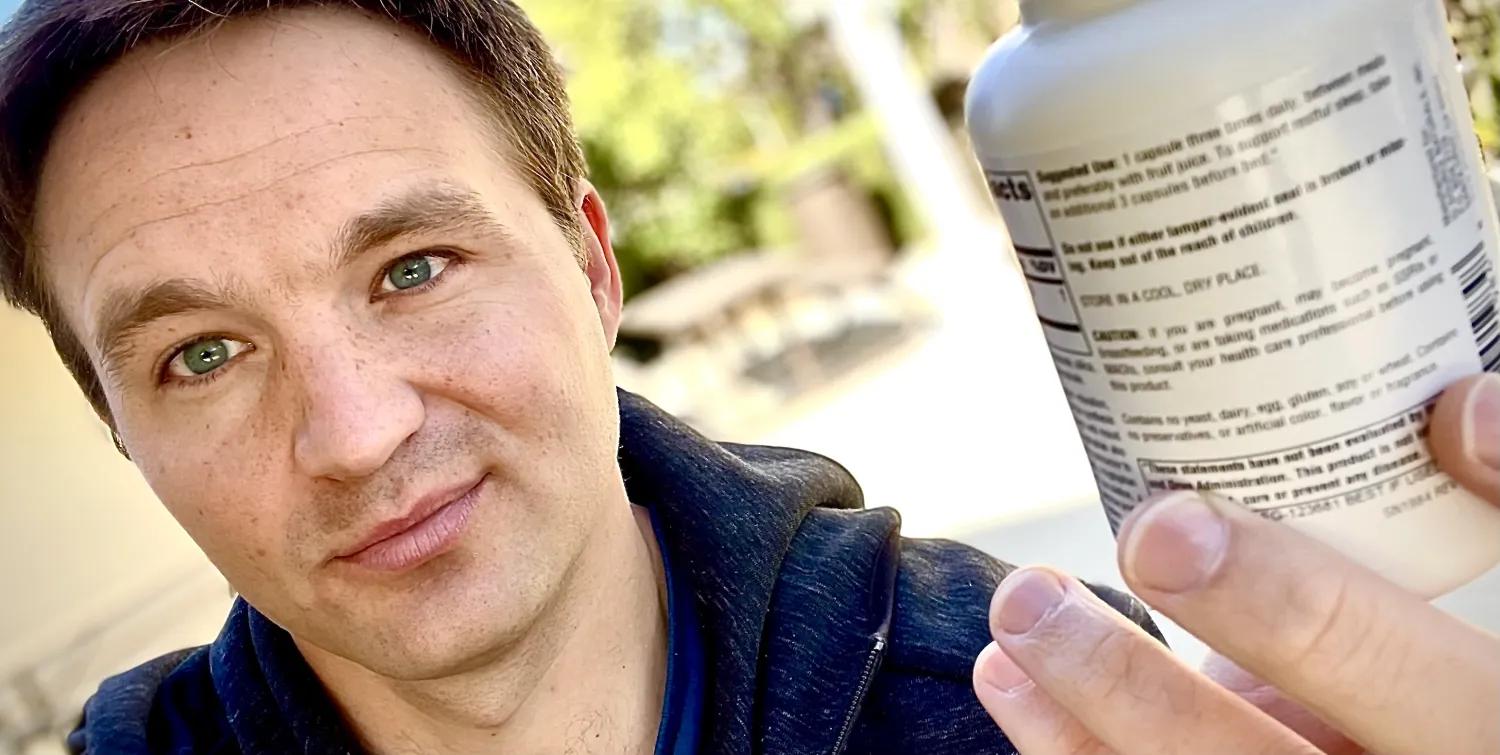
CHEAT: Boost your mood and slash appetite with potent emotion-hacking molecules. This is my secret weapon. In addition to frequent walks in the sunshine, use 5-HTP or Tryptophan, Tyrosine, and Ashwaghandha to (respectively) boost serotonin and reduce appetite, boost dopamine, and reduce cortisol – alleviating a significant portion of irritability, hunger, lack of joy, and elevated stress while adjusting to a calorie deficit. Read more about these tactics in my post about Emotion Hacking. (If you’re wondering, I’m holding a bottle of Tryptophan in the picture at the top of this article.) Out of these options, 5-HTP in particular has a number of human studies showing its effectiveness as an appetite suppressant – just don’t take this particular supplement if you’re on an antidepressant.
Hitting the basic tactics (particularly high protein and fiber) while also using a combination of caffeine, highly satiating meal replacements (e.g. with glucomannan), and these emotion-hacking, appetite-suppressing compounds may leave you feeling like you're cheating at weight loss. This is biohacking. These options do not require a prescription. That being said:
CHEAT: If necessary, use prescription-grade drugs to reduce appetite. Demonstrably effective options as I write this include GLP-1 agonists (like Ozempic, Zepbound, etc), which have been notably used by Oprah Winfrey, Elon Musk, and Serena Williams. Others include Qsymia (phentermine and topiramate), and Buproprion (often combined with Naltrexone). I wouldn’t be surprised if we see more cutting-edge medical technologies in this field in the not-too-distant future, along with much more widespread adoption of the current options. I haven’t personally experimented with these yet, but I respect anyone’s choice to use all the tools at their disposal to achieve a healthy weight. (By now I hope it's clear that when I say "cheat," it's truly not a negative moralization. I have zero problem with people using these drugs, provided it's done safely.)
I hope this serves as a concise summary of some effective and actionable principles, tactics, and “cheats” for eating less to lose weight. To be very clear, I do not mean to imply that the process will be quick, nor will it be effortless. Weight loss takes work and determination over time, and an ability to “stick with it” for the long run, even in the face of discomfort. However, I hope that some of these interventions themselves will be easy to implement and disproportionately helpful in making the process much more enjoyable.
Have fun, stick with it, and keep on experimenting.
-Dolan
This article is general fitness information from its author, not medical advice. Check with your doctor before starting a new exercise or nutrition program.
